

 Rhi McPhelim
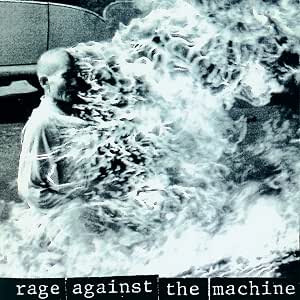
Rage Against the Machine’s self-titled LP stands as one of the most memorable debut albums of the 1990s.
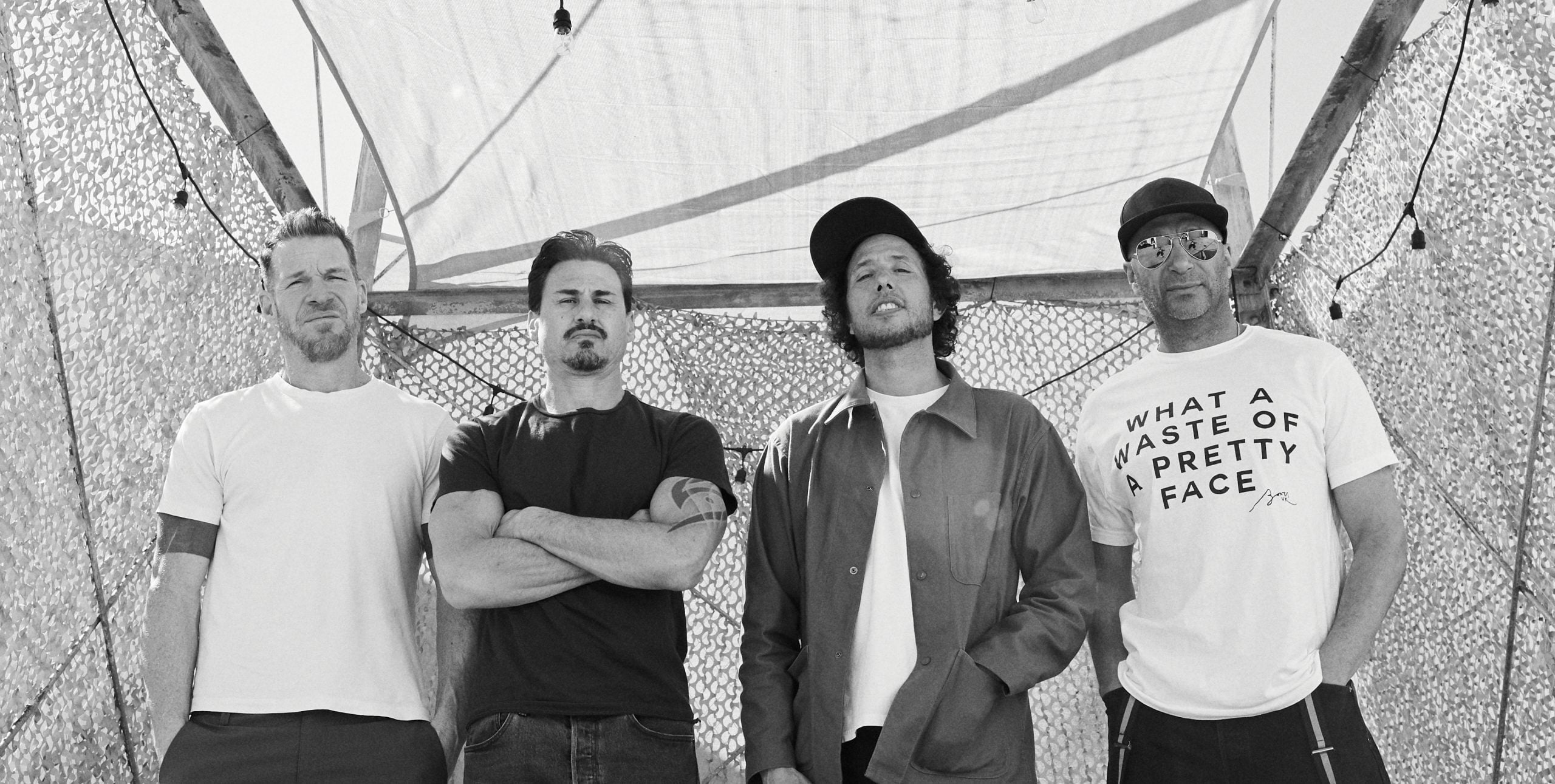
The band’s journey, from formation to being signed, to releasing this debut, was a swift affair by today’s standards. Formed in 1991 by vocalist Zack de la Rocha, the band comprised of bassist Tim Commerford, guitarist Tom Morello, and drummer Brad Wilk. They first recorded a twelve-track demo tape that became the blueprint for the debut album.
Several record labels knocked on the door in early 1992 off the back of the demo. But it was Epic Records, owned by Sony Music Entertainment, that would take them in.
Seven songs from the original demo became the core of the defining ten-track album. November 6th of that year was then set as the release date for Rage Against The Machine.
Track by Track
01 “Bombtrack”
“Bombtrack” opens the album with a menacing crescendo riff on unison bass and guitar. The riff quickly ascends and descends, growing in tension and volume before the snare helps it build to a climax. A grunt from de la Rocha affirms the song’s attitude.
At its core, the song calls out social inequality, which is a central theme across the band’s work. De la Rocha spits at “Landlords and power whores” and “militant minds”, pointing the finger at oppressive political and social structures.
At four minutes and three seconds, it’s the shortest song on an album from a band with a lot to say.
02 “Killing in the Name”
Released as the lead single about three weeks before the album, “Killing in the Name” held nothing back. And why would it? Rage Against The Machine have been unequivocally themselves since they put pen to paper.
The song’s lyrics were influenced by the beating of Rodney King by Los Angeles Police on March 3rd, 1991. In 1992, the officers involved were acquitted, resulting in riots across the LA metropolitan area and Orange County.
With eight iterations of “Some of those that work forces, Are the same that burn crosses” and sixteen declarations of “Fuck you, I won’t do what you tell me”, it’s a heavy anti-authoritarian anthem. One of the most provocative singles highlighting police brutality ever released.
Rolling Stone Magazine ranked it amongst their 100 Greatest Guitar Songs of All Time in 2002 (no. 24). It landed at number 207 on their list of The 500 Greatest Songs of All Time that same year. It has continued to find itself on similar lists over the past two decades.
03 “Take the Power Back”
“Take the Power Back” begins in a similar brooding vein to “Bombtrack”. The kick drum and bass guitar mimic a heartbeat, while Morello rapidly scratches his pick up and down the fretboard, spotlighting his experimental technique on a clean tone.
Commerford drills a foundation with a syncopated slapped bass riff in drop-D. Often noted amongst his best basslines, it features hammer-ons, pull-offs and some ghost notes. It is a real centrepiece of the song.
Morello, an effortless manipulator of his own sound, transitions from gritty rhythmic strumming to experimental picking, bringing layers of texture to the track. Wilk’s drumming is sparse but ever-effective. However, a section of the final quarter of the song does bring light to his softer finesse on cymbals and his dynamic control.
04 “Settle for Nothing”
Opening line, “A jail cell is freedom from the pain in my home” paints a stark picture of struggle. The sinister pivot between a low dynamic and minimal instrumentation and de la Rocha’s incredibly powerful, painful vocals shouting above screeching guitar, is gripping.
The song draws deeply from trauma, poverty and abuse. In some ways, it reflects elements of the difficult upbringings of each band member, particularly de la Rocha. But there is a universal lens of struggle. His raw, confrontational voice strains with the plea, “If we don’t take action now, We settle for nothing later”. Vocally, it is among one of the album’s most powerful and memorable performances.
05 “Bullet in the Head”
According to drummer Brad Wilk, “Bullet in the Head” was one of the first songs the band ever wrote. It featured on their original demo, and creating it marked one of the most tangible moments when they felt they had truly become Rage Against the Machine.
It was the second single released from the album and focuses on subjects of government-controlled media and censorship. For wider historical context, De La Rochard wrote the song around the time of the Gulf War in Iraq in the early 1990s.
This is a song that I wrote about the blanket of media that’s been thrown above our heads and can’t enable us to f–king act on situations like this because we don’t have the information to do so. This song is about being an individual, about searching and finding new information and using your strength as an individual to attack systems like America who continue to rob and rape and murder people in the name of freedom.
Zack de la Rocha
De la Rocha’s lyric delivery is rhythmic and conversational, but unflinching. At times, he is backed only by Wilk, making his statements all the more sharp.
Wilk’s drumming is a standout element. He anchors the song with his hip-hop / funk-leaning groove, which he slashes with crash cymbals and heavy snare in the chorus. By giving de la Rocha his space to speak, he creates all the more impact.
06 “Know Your Enemy”
Though it was never released as a single, “Know Your Enemy” is a widely-known track from the album.
It features Maynard James Keenan (Tool) and Stephen Perkins (Jane’s Addiction) on vocals and percussion respectively, making it quite the stacked collaboration.
Commerford’s slap bass chops feature again, for what I believe is only the second time on the album.
The song calls out for an anti-authoritarian fight, hissing at contradictory and corrupt power structures. Calling out notions of the “American dream”, de la Rocha brashly declares: “What? The ‘land of the free’? Whoever told you that is your enemy”.
Concluding with a repetitive spoken-word segment, it earns a nod as one of the most powerful song outros from the band’s discography:
Compromise, conformity, assimilation, submission
Ignorance, hypocrisy, brutality, the elite
All of which are American dreams (x8)
07 “Wake Up”
Fans of The Matrix will recognise “Wake Up” from the 1999 film’s closing scene.
Morello’s wailing, siren-like guitar defines the song’s opening moments, before the main drop-D riff barrels in. Described as “quintessential RATM”, it is another excellent display of Commerford and Morello uniting as thunder and lightning.
The lyrics address racist agendas within the US Government and the Federal Bureau of Investigation (FBI), referencing individuals like Martin Luther King JR. and Malcolm X, who were targeted by state surveillance.
The song features a sinister memo from J. Edgar Hoover, first director of the FBI, which which de la Rocha recites:
“He may be a real contender for this position should he abandon his supposed obedience to white liberal doctrine of non-violence… and embrace black nationalism. Through counter-intelligence, it should be possible to pinpoint potential troublemakers and neutralize them.”
08 “Fistful of Steel”
Track eight is one of the album’s most minimal. A thick continuous bass riff and heavy four four drum groove is the bedrock of the song, with Morello weaving in experimental textures throughout.
The song makes clever use of space, with de la Rocha’s first line being “Silence, Something about silence makes me sick”. The words “silence” and “silent” recur throughout, reinforcing a sense of absence and tension.
His syncopated vocal flow cuts right through the minimal backing, fittingly, like a fistful of steel. The “microphone” is symbolized as his weapon of choice.
09 “Township Rebellion”
The penultimate track pivots between two tempos, drawing parallels between anti-apartheid struggles in South Africa and oppressed communities across America.
The song’s faster side features a driving, gurgling guitar line from Morello and urgent cowbell from Wilk, with accented snare hits. The band switch to a heavy halftime style groove, somewhat sluggish, reflecting a tug-of-war struggle for freedom.
Following from “Fistful of Steel”, the song also makes strong reference to silence as complacence:
Why stand on a silent platform?
Fight the warm fuck the norm!”
10 “Freedom”
“Freedom”, the longest track on the LP, is charged with incredible intensity.
Like “Township Rebellion” it pivots between BPM changes, with De la Rocha screaming “Freedom” on behalf of the working class and oppressed groups.
The song’s music video, which premiered on MTV’s 120 Minutes in December 1993, looks at the controversial case of Leonard Peltier, one of the leaders of the American Indian Movement (AIM). He was convicted of murdering two FBI agents in 1975, but has maintained that he did not pull the trigger.
The track builds towards an explosive finale, with de la Rocha’s repeated cries of “Freedom” bringing the album to a haunting close.
Conclusion
Few debut albums have made such a statement as Rage Against The Machine.
They are a band of thinkers, observers and instigators – their awareness of social injustice at home and abroad fuels the album with a powerful universality.
There is so much power and identity to the LP. Each member functions as a powerful muscle of a singular whole. I can’t help but be drawn to each member individually as I listen to the album time and time again, dissecting each role in awe.
Over thirty years on, the album is not confined by the time its rooted in. It is a testament to the band’s enduring legacy.