

 Ronan O'Brien
When the Soviet Union collapsed in 1991, it opened the world to remarkable hidden talents. One of the most extraordinary discoveries from deep behind the Iron Curtain was Kino, a band far ahead of their time that you should know about.
Kinomania
Formed from a union of two bands in 1981, Kino is an idea more than just a band. Translated as “cinema” or “film”, the name was inspired by the neon lights in their native Leningrad (Saint Petersburg). Fronted by the enigmatic Viktor Tsoi and lead guitarist Yuri Kasparyan, the band had a smattering of wider members through their lifespan. Following drummer Oleg Valinsky’s conscription, the band resorted to using a drum machine for their later work.
Frequenting the Leningrad Rock Club, the band met the influential Boris Grebenshchikov. Through him, they recorded their debut album, 45. Operating in the underground magnitizdat scene, the band struggled to achieve prominence. That was until 1986, with the release of the band’s fourth album, Ночь. Despite selling over two million copies, the band received little royalties and negative press from the underground rock community.
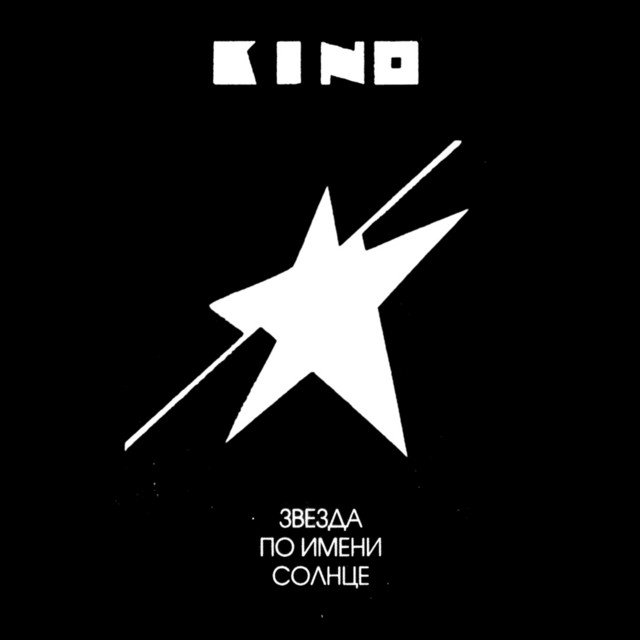
The popularity grew, which was expedited by Tsoi starring in several movies. New equipment meant better production, which is exactly what gave Группа крови its critical acclaim. In 1989, the band released the introspective yet genre-defying Звезда по имени Солнце. The album would be the last released before Viktor Tsoi’s untimely death in 1990 following a car collision.
A Star Called The Sun
The album opens with the bouncy synth and drums of “Песня без слов“ planting it firmly in the 1980s. The jagged edges of the guitars gnash away to create this raw edge, while the electronic elements maintain some solace. Tsoi’s vocals are deep and relaxed, matching the atmosphere beautifully. Assuming Google Translate hasn’t let me down, the lyrics detail similarities and opposites. From “Every star has its piece of the sky”, to “If there is darkness, there must be light”, the introspective mood is evident. Yet the narrator is pictured looking out his window with these thoughts swirling around his head. Maybe it is a song about nothing after all.
The title track, “Звезда по имени Солнце“ is one of the most interesting on the album. The listener will discover very quickly that each song has its own style. Yet the title track feels like a mix of everything, which is a cool touch. The blend of electronic and traditional rock elements work so well here, it even feels gothic and indie at the same time. While the lyrics portray a backdrop of typical Soviet life at the time, the context of its release around the Soviet-Afghan War gives it a powerful political stance. The anti-war messages are rife in lyrics, especially “War is a young man’s business / Anti-wrinkle medicine / Red-red blood / After an hour it’s just earth.”
The heavier guitar tones of “Невесёлая песня“ create such a foreboding effect that works incredibly well. Almost in a metal arrangement, the beat pulsates ceaselessly. Tsoi’s vocals are fantastically suited to it too, and the lyrics as an unhappy song really sell it. Commanding that his sad song be played, his delivery is almost celebratory. Russians have a stereotype about being gloomy, and maybe that’s what makes this perfect.
White, White Days
“Сказка“ opens with an instrumental comparable to that of The Cure. The discrete, gothic nature of the track is reflected aptly in the lyrics. Tsoi softly details the imagery of “A fairy tale with an unhappy ending”, rife with depictions of the Soviet background. The song is slow and dragged out, but it works with such delight. The prolonged instrumentals give much more character to the song, with the guitars echoing the gloomy undertones of the tale.
The style drastically changes in “Место для шага вперёд“, which takes a much funkier approach. The syncopated guitar and consistent hi-hats give this track such great energy. Tsoi’s delivery is just as emphatic. His anthem-style chorus empowers the listener, coupled with lyrics detailing freedom and resistance. Tsoi has a truly laconic style, and his need to step forward despite obstacles is reflected in this song as much as it was in his own life.
One of the band’s most popular songs, “Пачка сигарет“, opens with space rock style guitar and drums. An incredibly enjoyable track, the guitar is subtle accompanying Tsoi’s vocals before really shining. It’s another one with a gloomy atmosphere, but the lyrics detail somewhat optimism. It simply details how life isn’t so bad when you have a pack of cigarettes in your pocket. How bad eh?
Where Did The Sadness Come From?
Another stylistic change comes in the form of the roots rock-inspired “Стук“. The driving guitars and drums almost imitate a horse’s gallop in the style of a Western movie. Tsoi is vocally more present in this track, and the impassioned lyricism supports that energy. Laying his inner thoughts out, he details the unremitting desire to “hit the road” with belief.
The jangly guitars and pan-flutes of “Печаль“ make it reminiscent of an early R.E.M track. The melodies are bright and beautiful, yet still have this melancholy about them. This is especially evident in Tsoi’s vocal delivery and lyrics depicting the cityscape around him. There is a moment for the guitars to shine in the interlude with some really cool distorted tones, it takes the track to a whole new level.
The album ends with a folk-style track that is “Апрель“. The stomp-clap of the drums and sparsely jangled guitar certainly give it that feeling, but the chorus-like vocals dispel any expectations. For the first time, Tsoi’s vocals are layered and full of reverb. Again, the lyrics almost counter the mood. There is hope, almost like the Second Coming of Christ, who “will come and bring spring with him”.
Final Thoughts
One thing I absolutely love is listening to albums whose lyrics are in a completely foreign language to me. Not only does it make me concentrate more on the songs as a whole, but it also shows that music is universally understood and accessible to everyone. A friend recommended this album to me years ago, and it’s stuck with me since.
As mentioned, Kino were decades ahead of their time. It’s incredibly rare to find an album which has a differing yet distinct style to each track. That’s not forgetting that this album was recorded entirely behind the Iron Curtain, where Western influences were few and far between. While the band did indeed experience Western influences, their own stamp is heard across the entirety of this project.
For anyone who stumbles across this review, I implore you to listen to this album in its entirety. It’s absolutely phenomenal from a band whose influence barely left the Soviet borders. And that is a great injustice, as Kino should be considered legendary globally.