

 Matt Lucey
An Intro the the Legend
By the time Station to Station arrived in 1976, David Bowie was already several artists deep into his own career. Born in London in 1947, Bowie showed signs of creative restlessness early on. He studied art and music, gravitated naturally toward performance and dance, and was introduced to jazz at the age of ten by his half-brother — a moment that would quietly shape his musical instincts for decades. Even before fame, Bowie understood that music didn’t just sound a certain way — it looked and felt a certain way too.
Early Career and attitude towards music
His early career was defined by boldness and a willingness to be strange. Albums like David Bowie (1969), Space Oddity, and Aladdin Sane built momentum, but it was The Rise and Fall of Ziggy Stardust and the Spiders from Mars that cemented him as a generational figure. Ziggy wasn’t just an album — it was a moment, a character, a statement about identity and performance. Bowie didn’t simply write songs; he inhabited them.
By the mid-1970s, however, critics began to view Bowie’s output as uneven. Diamond Dogs and Young Americans were ambitious but didn’t land with the same universal acclaim as his earlier work. At the same time, Bowie was navigating one of the most intense and controversial periods of his life. As always, he responded by creating another persona.
Enter the Thin White Duke.
Unlike Ziggy Stardust or Aladdin Sane, the Duke was colder, sleeker, and more unsettling. A cabaret-inspired figure dressed in sharp lines and emotional detachment, this character came with controversy. Bowie made statements during this era that were widely criticised, later clarifying that they did not reflect his personal beliefs but rather the mindset of the character he was inhabiting. The Duke wasn’t meant to be likeable — he was meant to reflect alienation, excess, and detachment.
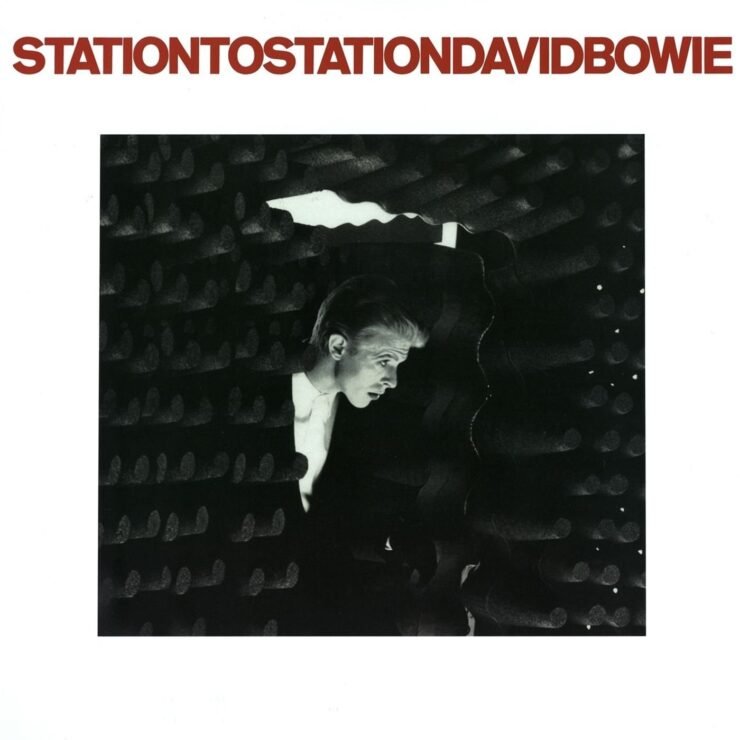
Station to Station was the album built entirely around that persona.
Released in 1976 on RCA and produced by Bowie himself alongside Harry Maslin, Station to Station contains just six tracks — yet it feels vast. Rather than scaling back, Bowie used the limited tracklist to stretch songs outward, allowing moods, grooves, and identities to evolve within single pieces. The album marked a pivotal transition in his sound, bridging the funk and soul influences of Young Americans with the experimental direction that would soon define his Berlin era. Over time, it has become one of his most beloved records, praised for its innovative fusion of soul, funk, rock, and European art sensibilities.
Station to Station
The title track, “Station to Station,” sets the tone immediately — and unapologetically. It fades in with an oscillating, mechanical soundscape, soon joined by a distant guitar and an unnerving two-note melody that feels deliberately uncomfortable. As percussion slowly enters, the song finds its groove almost reluctantly. The instruments feel disconnected at first, circling one another, before eventually syncing into a tight, hypnotic rhythm. The first third of the track is a slow burn, with the tempo subtly increasing and tension steadily building.
When Bowie’s vocals finally arrive, they command attention instantly. His delivery is confident, theatrical, and deeply assured. Lyrically, the song showcases his gift for storytelling — nothing overly complex, but meticulously constructed. Halfway through, the track undergoes a dramatic tonal shift. The darkness lifts, the tempo opens up, and piano enters to bring a sense of levity and release. By the time the song ends, it feels celebratory, almost euphoric. It’s a masterclass in structure — proof that Bowie understood exactly how far a song could bend without breaking.
Word on a Wing
“Word on a Wing” offers a striking contrast. It opens with a monotone vocal over gentle piano before drums gradually join, grounding the track. A softly wailing guitar sits in the background, adding texture rather than dominance. Bowie’s vocal performance here is notably tender, revealing a vulnerability that the Duke persona often masked. Harmonised backing vocals give the song an ethereal quality, almost spiritual in tone. It’s a reminder of Bowie’s extraordinary range — not just technically, but emotionally. Where Station to Station is all tension and transformation, Word on a Wing feels reflective and exposed.
Stay
Then there’s “Stay,” a song driven first and foremost by rhythm. It opens with a sharp, infectious riff punctuated perfectly by drums, allowing the groove to build without ever stagnating. The bass is especially prominent, giving the track a feel that would heavily influence the coming decade — it’s not hard to hear echoes of early ’80s post-disco and funk-rock here. The guitar work becomes increasingly loose and wild as the song progresses, nodding to the sloppier, more expressive styles popularised by bands like Led Zeppelin. Bowie’s vocals initially sit back, letting the rhythm take centre stage, before fully stepping into the mix. It’s an essential piece of the album — energetic, stylish, and effortlessly cool.
Final Thoughts
As a whole, Station to Station stands as one of Bowie’s defining achievements. It captures an artist in flux — not retreating from uncertainty, but leaning directly into it. Bowie excels here as a songwriter, a performer, and a curator of sound, capable of holding a listener’s attention for eight minutes as styles shift and moods transform, then turning around and making you want to dance.
This album isn’t just a high point in Bowie’s catalogue — it’s a statement. Another moment where he rewrote the rules, challenged expectations, and solidified his place among the greatest artists popular music has ever produced.