

 Richard Bodin
If there is one act that made it through the ages and has earned the status of Legend, this is definitely Elvis Presley. Oh I am sure you all have in mind the ridiculous Las Vegas impersonators, too often commemorating his later days accoutrements. Unfortunately, this is part of being a legend: you inspire people in every possible way. But what exactly turned a poor hillbilly into the King of Rock n Roll?
Where It All Began
Nobody would have gambled on young Elvis. He was born in poverty just before World War II. His family relied on government food assistance, and the goodwill of the neighbours. At school, his teacher found him average at best. He was gifted with a guitar for his tenth birthday, and learnt to play it with a few relative. He played everything by ear, and would often go in the record shops and occupy the listening booth for hours. Like a sponge, he developed his influences, which were very much eclectic. He would listen extensively to country music, be fascinated by gospel music, listen to what was then called “race-music” on the radio (blues, spirituals, and of course rhythm ’n blues).
With such a vast influence, while not able to read music, Young Elvis came up as an odd duck. But he was decided: music would be his career. While he was not able to find a band that would have him, he kept trying and would play whenever he had the chance. At the time, you could also pop in a recording studio with your guitar, and for a few bucks, have your own music pressed on acetate. That is how Elvis Presley met Sam Phillips, who was just about founding Sun Records and change his life. Sam Phillips believed in black music, and wanted to bring people to it. At the time a good way to do so was to have white people to perform it, as a gateway. With Elvis Presley, Phillips met a kindred spirit.
The session that would change everything
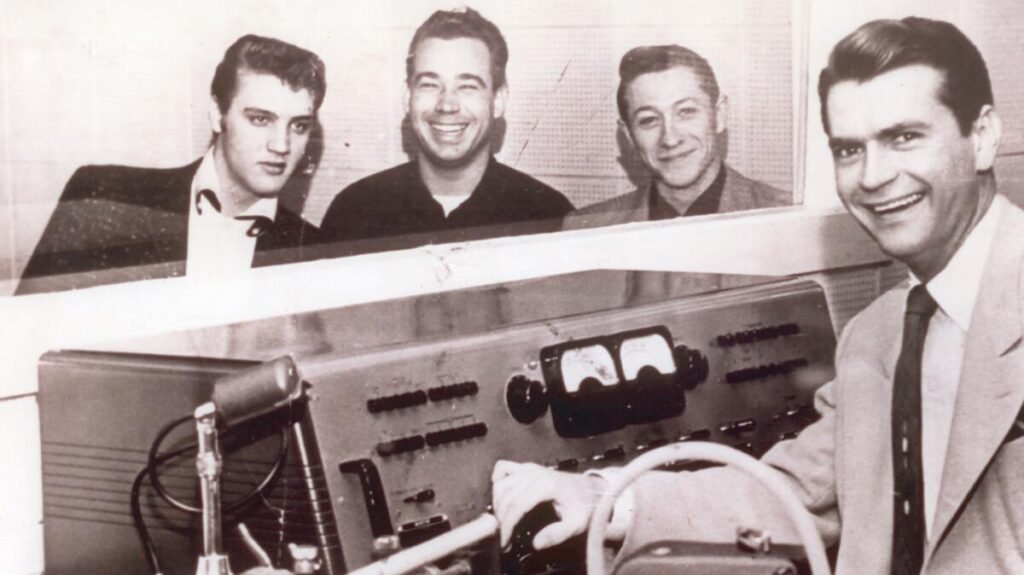
One day, in July 1954, Phillips got his hands on a demo of “Without You” by Jimmy Sweeney, and he thought of Elvis to cover it. He brought in two local musicians to accompany him: Scotty Moore (electric guitar) and Bill Black (double bass). The sessions however proved unfruitful. As they were ready to give up and part ways in the late hours of the night, Elvis threw himself into a hectic rendition of “That’s All Right” by Arthur Crudup. Moore recalled: “All of a sudden, Elvis just started singing this song, jumping around and acting the fool, and then Bill picked up his bass, and he started acting the fool, too, and I started playing with them.” Phillips, delighted, had found the sound he was looking for and started recording.
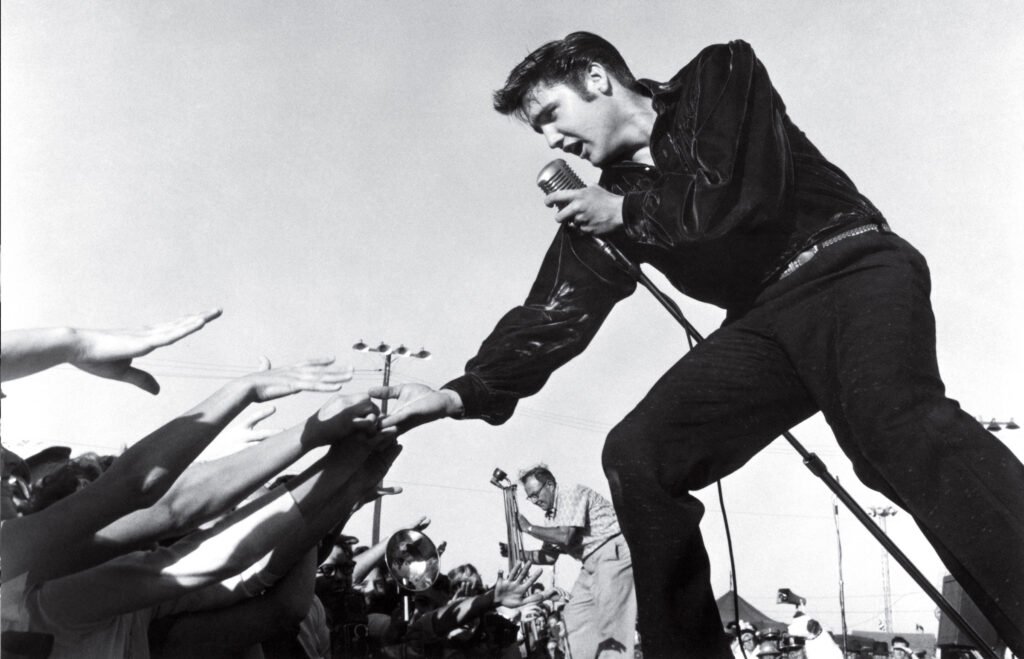
In the following weeks, the single was running in loop on the local airwaves. Interviewed on-air, Presley was asked what highschool he attended to answer callers thinking the singer was black. The two other musician soon left their band to keep playing with Elvis, as they evolved to be locally acclaimed. With time, they would record other singles, and playing multiple live performances. During those, Elvis would start spinning heads with his stage antiques. He would adopt a wide stance, and responding to rhythm and also to relieve his nervousness, his hips would start shaking like rubber.
The Making of the King
Despite their local fame, Elvis and his band was finding it difficult to pierce on a national level. You see, their wide influence stretching from blues or gospel, to country music made it difficult for radios to find a spot for them. Country Music radios would find them too leaning on the black music, while the RnB stations would find them too hillbilly to be taken seriously. Their blend, quite unique at the time, was soon coined as « rockabilly ». In 1955, Col. Tom Parker, Presley’s infamous manager, along with Philips, managed to struck a deal with RCA Victor to buy Elvis’ catalogue from Sun Records. The label soon republished his earlier singles and promoted them heavily across the country. The move would allow Presley to reach a wider audience.
Early in 1956, Presley and his band had their first recording session with RCA Victor and producer Stephen Sholes in Nashville. What came out of these sessions was “Heartbreak Hotel”. Parker managed to get Elvis to perform on the Stage Show, the Dorsey Brother’s television program, six weeks in a row. This drove the single to hold the first spot in the Charts. To capitalise on the success, RCA wanted to release an album. Elvis had just finished a second session in their studios in New York, which combined with the first session left them eleven new tracks, just enough for a new LP. But… some of them had great single potential, and at the time, that meant great commercial potential. So they kept some aside, and used material recorded with Sun Records to complete the album.
A Cultural Earthquake
On March 13, Elvis Presley’s debut album was released. And boy… did it drop like a bomb…
« Well it’s a-one for the money, two for the show »… It opens straight with the electrifying “Blue Suede Shoes”… I dare anyone to listen to that track and not feel the urge to shake hips and click fingers. It was, and still is an absolute banger by all accounts. Now think of the change in a mid 50s musical landscape. The best selling artists back then were still Frank Sinatra, Bing Crosby or Harry Belafonte! Imagine the devastating effect of “Blue Suede Shoes” after “Banana Boat”! The youth had their new idol right there.
Elvis the Crooner
It was followed by “I’m Counting on You”, a nice little country ballad. Elvis here shows how versatile he can be. He sings like a crooner, but with his own rockabilly flair. The album will explore this more sensible side of him with three other tracks. “I Love You Because” and “I’ll never Let You Go (Little Darlin)” were both tracks recorded in Sun Studio. Sam Philips at the time wasn’t too sure they were the right thing for Elvis. And although they are quite good as is, his vocal mannerism are pushed to such extent on “I’ll never Let You Go” that it gets almost ridiculous. The last ballad is the slow “Blue Moon”, which soars into odd falsetto parts, which doesn’t fare much better…
Elvis the rocker
In 1955, Presley had opened for Bill Haley & His Comets who reached number one with their Rock single “Rock Around the Clock”. Very quickly he caught on Presley’s natural instinct for rhythm and advised the future King to sing fewer ballads… He was damn right. The whole strength of this album lies in this fast paced tracks imbued with pure concentrated rock n roll. Elvis, here covers two tracks by artists known for sense of rhythm and powerful interpretation: “I’ve Got A Woman” by Ray Charles, and “Tutti Frutti” by Little Richards… Elvis’ rendition are something else: he plainly outshines the original… On “Tutti Frutti” you can almost hear the hips shaking all through his body and vocal chords.
Apparently Elvis couldn’t stand still. Not a hope. To the greatest despair of the recording engineer. They would assign him a spot, in front of the mic, so they could obviously capture his voice correctly. But it was beyond him, he was bound to move, feel the music through his body and shake. Eventually the engineers gave up and surrounded him with microphones.
The Power of a Photograph
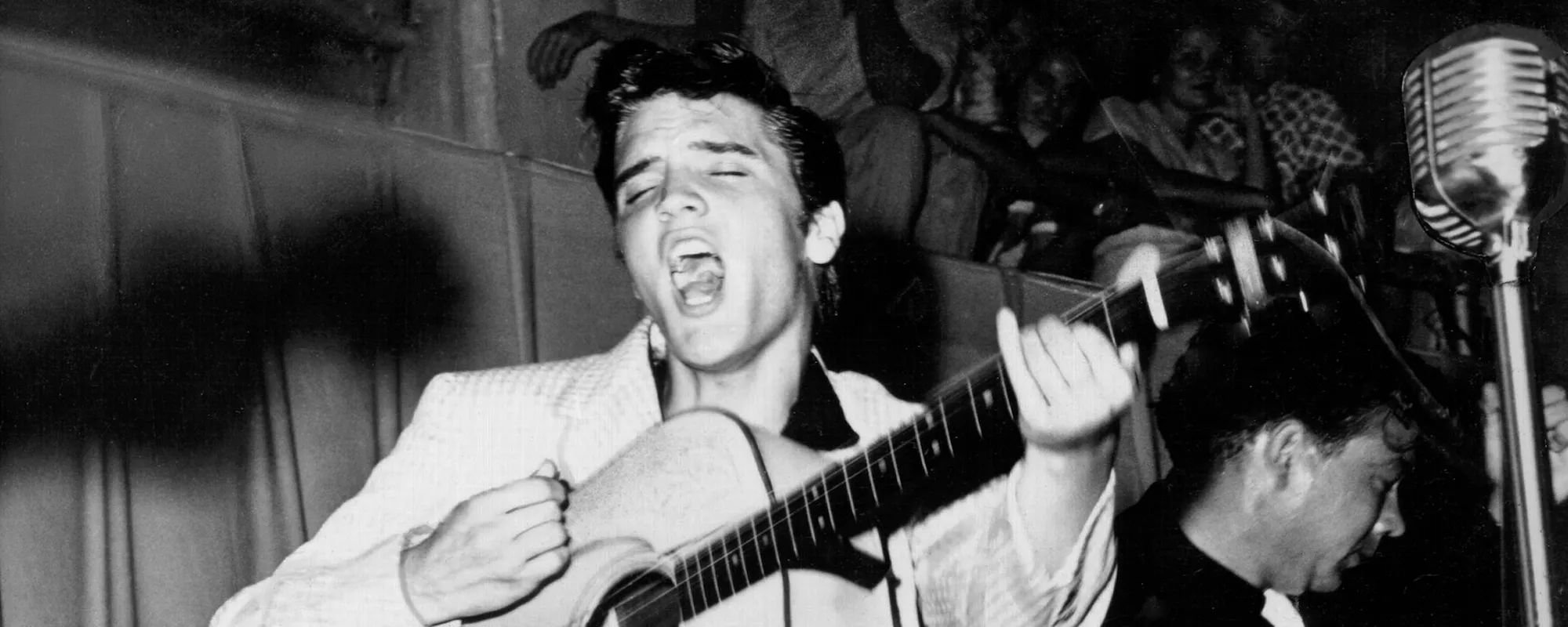
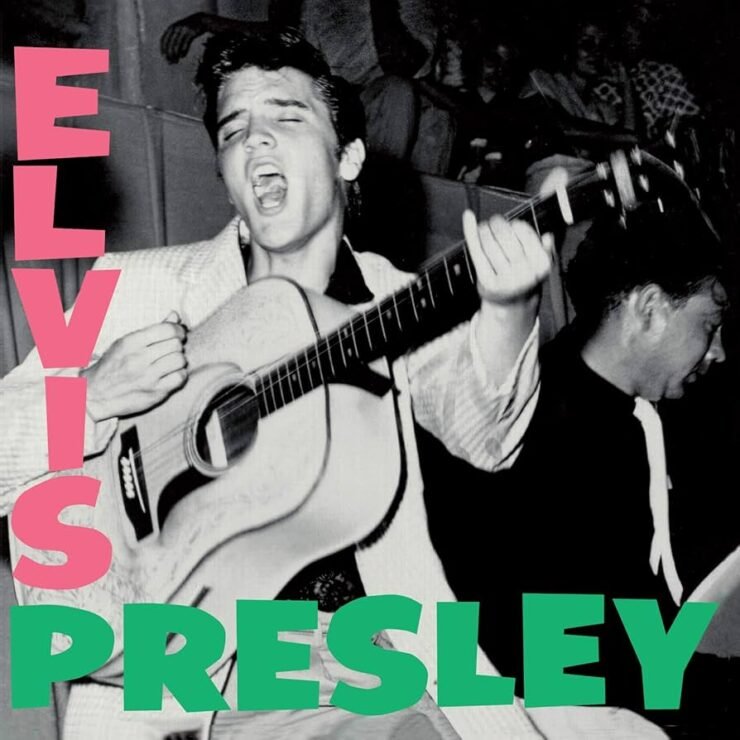
This energy transpires all the way through to the album’s artwork, which went down in history last the 40th Greatest Album Covers according to Rolling Stone Magazine in 1991. The photograph chosen to represent the album also breaks away from tradition. No awkward pose, no polite smile, no attempt to make Presley respectable. The chosen action shot was captured by William V. “Red” Robertson during Elvis Presley’s live performance in Tampa, Florida, on July 31, 1955. The image captures him mid-performance, frozen in his signature hip movement, mouth wide open as if the sound itself was tearing through him. Even the bright pink and green lettering spelling his name and framing the image seemed to vibrate with the same nervous energy. The message was clear. This was rock ’n’ roll.
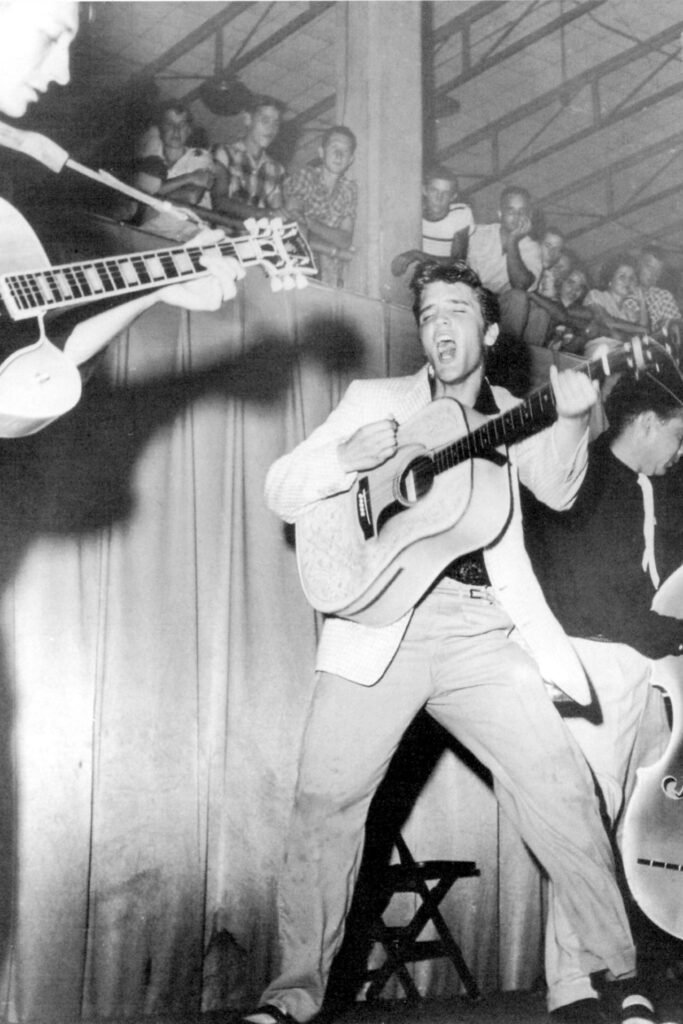
When the album came out, it was met with big success. Elvis Presley’s debut album became the first rock album in history to reach the first place of the charts, where it remained for 10 weeks. It was also the first rock album to sell over a million copies. The first album to ever do so was Harry Belafonte’s Calypso release the same year actually…
“Elvis the Pelvis”
Of course when someone reaches fame like this in America, it doesn’t got without a little bit of controversy. Just like Beatles’ albums were put to flames a decade later after Lennon claimed the Beatles were more popular than Jesus, the conversative fringe of society didn’t see Elvis’ antiques in a good eye… Not only was he covering music by black artists, but Elvis the Pelvis had the devil in him. A damning letter was addressed to John Edgar Hoover, head of the FBI, from LaCrosse’s catholic diocese after one his show. It said:
« Presley is a definite danger to the security of the United States. … His actions and motions were such as to rouse the sexual passions of teenaged youth. After the show, more than 1,000 teenagers tried to gang into Presley’s room at the auditorium. Indications of the harm Presley did just in La Crosse were the two high school girls… whose abdomen and thigh had Presley’s autograph. »
« A danger to the security off the United States »… nothing less.
« Before Elvis, There was nothing… »
Nevertheless, Elvis went on to become the legend that we know today. Not only did he make a name for himself throughout history, but more importantly he proved to countless teenager around the world, that it was possible for anyone to get up on stage, rebel and transcend social origins, or even cultural backgrounds. John Lennon famously said « Before Elvis, there was nothing ». It is of course a bit of a stretch… Richard Berry, Little Richard, Bo Diddley or even Bill Haley had been trailing the fields already. But Elvis made it mainstream. His impact was seismic. Without him, Lennon would maybe not have been inspired to form The Quarrymen, and we would never have had the Beatles.
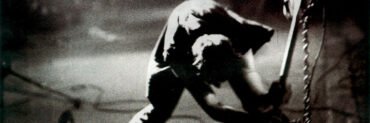
His legend has gone through decades without ever fading. In many ways, Elvis can be seen as one of the first true punk figures. Stemming from a working-class background, refusing to conform, and unsettling polite society simply by being himself —well at least in his early career. Decades later, The Clash paid tribute to the King by recreating his album cover for London Calling. They replaced Presley’s energetic stance, by Paul Simonon smashing his bass on stage, and framed it with the name of album spelled with the same bright pink and green lettering. The attitude remained the same: rebel, raw with the same sense of urgency. Rock ’n’ roll had found its image in 1956, and every generation since has been chasing that same moment of dangerous freedom.
The gilded cage
Yet behind every legend stands a human being, and often, a manager. As Elvis’ fame grew, so did the grip of Colonel Tom Parker. Parker understood spectacle and profit better than he understood art. Under his watch, Elvis became a global phenomenon. But also a carefully controlled product. The focus shifted toward Hollywood, and a string of safe, predictable films gradually diluted The King’s image.
Because of Parker’s own precarious immigration status, international tours were largely avoided. The manager controlled nearly every aspect of Elvis’ career, from contracts to creative decisions. In time, The King found himself locked into lucrative but rushed deals and never-ending Las Vegas residencies. Financially successful, yes, but artistically restrictive. One cannot help but wonder: what might Elvis Presley have become had he been allowed to fully explore his artistic potential?
And yet, none of that can erase what happened in 1956. That first album remains untouched by compromise. It captures Elvis before the gilded cage, before Las Vegas, before the myth hardened into caricature.